
As the new co-chair of Compass, I was delighted to have been invited to give the opening speech at this year’s annual conference, Change: NOW. A day full of inspiration and insight. And a very clear understanding of the critical moment we’re in. Without a fairer voting system being introduced before the next election, we face the very real possibility of Nigel Farage being handed the keys to Number 10 on barely a quarter of the national vote. My speech here:
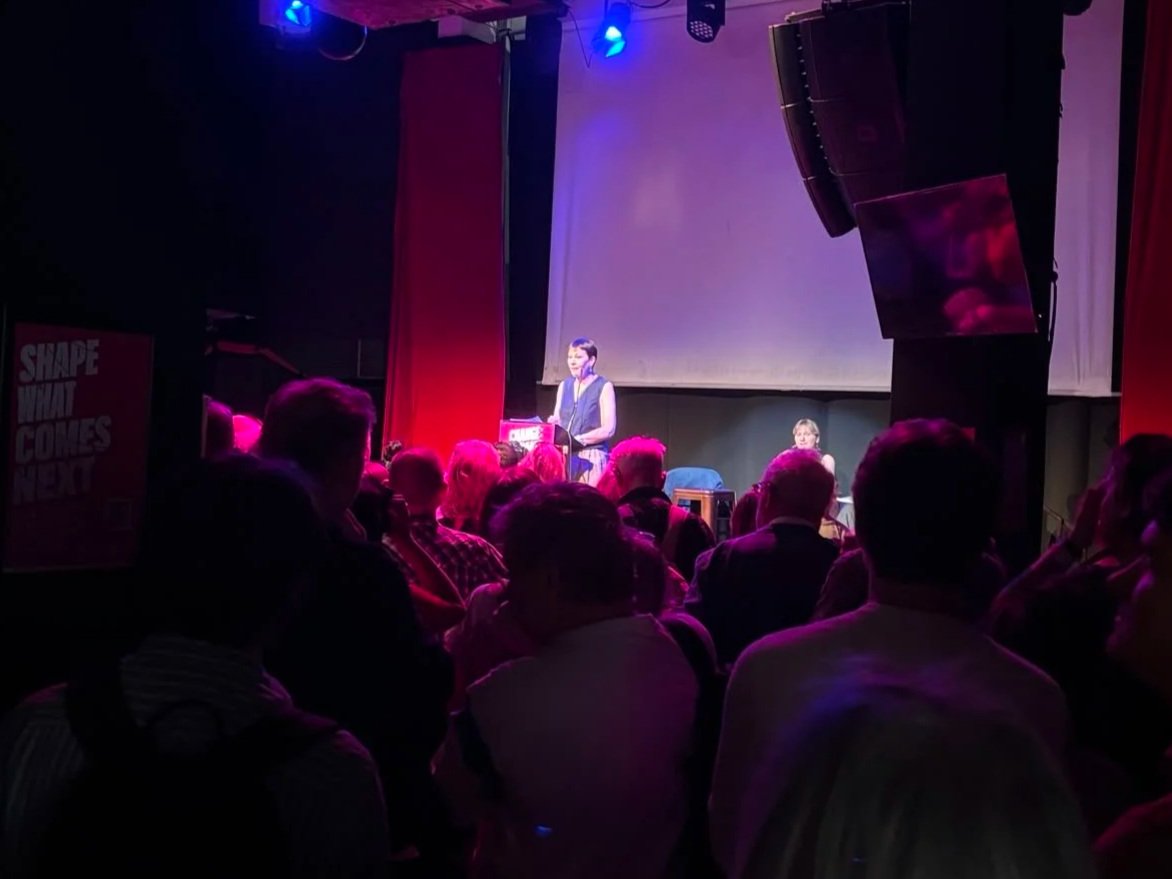
Compass: Change Now conference, May 2026
1.Introduction
Friends, welcome to this amazing Compass Conference!
I couldn’t be more excited that we have such an inspirational, innovative and insightful set of thinkers and speakers, do-ers and dreamers, writers and organisers with us today. And I couldn’t be more delighted, as a new Co-Chair of Compass, as well as a former Green Party leader and MP, to have been asked to open the Conference with a few words of introduction. So thank you for being here.
The fact that so many of you have made this a priority today sends a very clear message:
We recognise the overwhelming threat posed by the rise of the far right
We know they succeed when progressive forces are divided and defensive
And so we’re here to show that change is possible through collective organising, forging alliances, and building trust…
…Because we know that’s both the only way we defeat Reform – and the only way we defeat the causes of Reform as well.
So I’ll make 3 brief points:
First, that this month’s local election results demonstrate that, in spite of major gains for Reform UK, there is still a progressive majority in this country. Our challenge and our responsibility is to start to act like one.
Second, that if we’re to face down the Far Right, cooperation between progressives is not only necessary but also – possibly more controversially! – desirable as well. And that’s why a fairer voting system is essential - both because it offers us the best chance of transforming our political system and keeping Farage out of Number 10, and because political pluralism delivers better politics.
Third, the stakes are so unimaginably high, and the risks of a Reform-led government so very real. Fixing our democracy will require levels of boldness and bravery that, collectively, quite frankly. we have never been able to muster before. This has to be the moment when that changes and when all of us step up.
2. Progressive majorities
May’s local election results demonstrated beyond doubt that Two Party Politics is not just dying….
Friends, Two Party Politics is dead and buried
For Labour the results were a catastrophe
… an object lesson, as Clive Lewis has said, in what happens when a social democratic party refuses to challenge the neoliberal economic orthodoxy of the last 40 years
… An orthodoxy which has pushed us into climate chaos, hollowed out public services, privatised what was ours, driven inequality to obscene levels, and rolled out the red carpet for the authoritarian right.
That’s why Labour lost nearly 1500 seats as well as control of over 30 councils across England, while Reform won over 1400 seats, and took control of 14 councils. These were good elections for the Greens. We won a record 587 seats, gained control of 5 councils, won 2 elected mayors in Hackney and Lewisham, and our first 2 seats in the Senedd. The BBC national vote projection calculates how all of these local results would translate into a national result at a General Election.
In terms of the new bloc politics, it gives the Right 43% and the Left 51% - that puts us comfortably ahead, even before taking into account Plaid’s success in Wales and the SNP’s in Scotland.
I know I’m simplifying here: we all know there are some Libdem and Labour people who aren’t that progressive - you only need to recall the coalition government or the Government's shameful complicity in the genocide in Gaza to know that. But we also know it’s possible for those parties to orient in broadly progressive directions - think of decarbonisation under Ed Miliband
So I think it is clear that there is still a progressive majority in this country.
But it’s also clear that no single party can defeat the populist Right on its own.
Stopping Reform and rebuilding the country is bigger than any one party.
And there are lessons in that for all of us.
And so to Labour, I’d say - No-one knows what politics will look like by the time of the next election – nor which party on the left will be the main challenger. But until the next election we know for sure that a Labour Prime Minister is the only route to democratic change.
And that means you really do have to step up and deliver on a genuinely progressive agenda.
We know from the bitter experience of Keir Starmer that Labour politicians can make countless shiny pledges to the Left – before promptly torching them as soon as they gain office. That can’t be allowed to happen again.
And to my own Party colleagues, I’d ask them to consider that even if the Greens increased our seats tenfold at the next General election – or even more – would that be the best outcome for green politics if, at the same time, Nigel Farage were handed the keys to Number 10? I believe that all of us who see ourselves as progressives have to change the way we organise, broaden our culture, expand our political imagination….
…And finally abandon the tribalism that has fractured progressive politics in this country for far too long.
We urgently need to do politics differently – and that’s what today is all about. Building trust, and deepening relationships now, not just a few weeks before an election campaign.
3.Cooperation and PR
I’ve been advocating a more plural politics for well over a decade. Almost exactly 10 years ago, I co-edited a book of essays on progressive politics withLabour’s Lisa Nandy and Chris Bowers from the Libdems. In our joint introduction, the three of us wrote:
“We are not proposing cooperation among the progressives because we have to, but because we want to. Quite simply, we believe that political pluralism delivers better answers and better government.”
I believed it then, and I believe it today. I’ve made the case that no single party can defeat the populist Right on its own.
But this isn’t just about the electoral calculus
It’s about something much more profound
A recognition that nobody and no single political party has a monopoly on wisdom.
An understanding that no party has an inalienable right to hold on to its power.
Now the Green Party has been badly burned in the past by an attitude from some in Labour that amounted to telling Greens to simply get out of the way. That cannot be the approach in the future. Not when so much is at stake. And not when the public have so clearly voted to reject a politics in which 2 parties dominate, and where everyone else is expected to dance to their tune.
Shaping a new political culture requires a different strategy and a bolder set of goals.
We face huge challenges ahead…
So let’s start to stack things in our favour – Not to shut the door on the potential to transform the future because someone with the skills or ideas we could use is in a different tribe.
Our allies are in the unions, civil society groups, grassroots mobilisations, green and social justice groups, racial justice groups, refugee rights campaigns – and yes, sometimes, in other parties too.
To fix Britain, we’ve got to break open the system. Open up to new forms of power and politics – better distributed, more diverse. And a fairer voting system has to be at the heart of that transformation.
4.Electoral reform
The Palace of Westminster, Gothic, rat-infested and crumbling into the Thames, has become a powerful symbol of political decay. The electoral system that sends MPs there is a crucial part of our democracy – Democracy that is not just a means to an end, but a value that expresses how fair, how open, how equal we are as a society.
A fairer voting system isn’t just about arithmetic outcomes – it’s about changing the wider political culture. Under Proportional Representation, to win, politicians can’t just rely on the votes of their tribe alone. They’re forced to reach out across party divides to the wider electorate – and to those typically excluded from political calculation.
And by a happy coincidence, a fairer voting system also makes a return to the EU far more plausible, since we could demonstrate to our EU partners that our decision to rejoin is one they can trust, one that won’t simply be reversed with a change of government.
With the UK on course to see its 7th Prime Minister in a decade, it’s clear that First Past The Post now delivers radical instability. Replacing this distorted and undemocratic system with PR would prevent ever again the absolute dictatorship by one party with only a small minority of the vote.
Andy Burnham’s commitment to electoral reform is why the Makerfield by-election matters so much. He is not the Messiah.
But right now, if he recommits to PR at the earliest possible opportunity – and I’d argue that if he becomes Prime Minister, he could introduce a fairer voting system in time for the next election, then he is our best hope of stopping a far right government gaining the keys to Number 10 on barely a quarter of the national vote.
5.What’s at stake if we don’t
For anyone still unpersuaded of the scale of the risk Reform UK poses, I'd respectfully suggest you've not been paying attention. Because Reform has made no secret of their plans to roll back decades of progress on environmental protection and human rights.
To deport as many as 2 million people.
Establishing a UK version of Trump’s ICE programme, grabbing people off the streets, building mass detention centres and forcing people of colour to prove their right to be here.
Slashing any action to address the climate emergency, repealing equality legislation and workers’ rights, massively cutting public services and dismantling the NHS.
Further corroding and corrupting our politics and our democracy
The mainstream media should stop treating them as if they are just another political party, because they are not.
What dangerous complacency is there in the UK that leads so many to think that the rise of the far right in Europe and elsewhere can’t happen here?
Friends, it can and it is.
It’s before our eyes. Right now.
The brilliant and fearless organisation Hope Not Hate produces an annual State of Hate report. This year, they conclude: “The far right is more extreme, bigger and bolder than ever before.” In the words of their founder Nick Lowles: “I’ve been fighting fascism now for over 35 years and I’ve never known a time like this.” This, coming on top of radical climate and nature breakdown and spiralling inequality, must galvanise us into new ways of working.
6.Conclusion
Friends, in conclusion, this is a time for bravery. For leadership with the courage to bring bold ideas to the table and the confidence to go out and win public support for them. We need to agree values before tactics, that’s true. But the brave thing to do isn’t to hide behind our values or use them as an excuse to continue doing politics in our tribes.
The brave thing is to seek out those with whom we have more in common than divides us. To work with them when we can, and robustly call them out when they get it wrong. Even if the electoral maths did stack up and Labour could get more MPs under FPTP, that still isn’t winning big enough.
We saw evidence of that with the 2024 “loveless landslide” – 63% of the seats on less than 34% of the vote, the lowest vote share ever to produce a majority government. As a result, Labour’s majority is brittle and unstable.
To really win is to win people’s hearts and minds.
To promote a politics that is generous by design. A politics that is grounded in trust, openness and the redistribution of power and resources. Winning the future cannot be done by any political leader going it alone. The stakes are too high.
Winning the future needs a new kind of political leadership for a new political culture. And that’s what we start building today.
Thank you.